
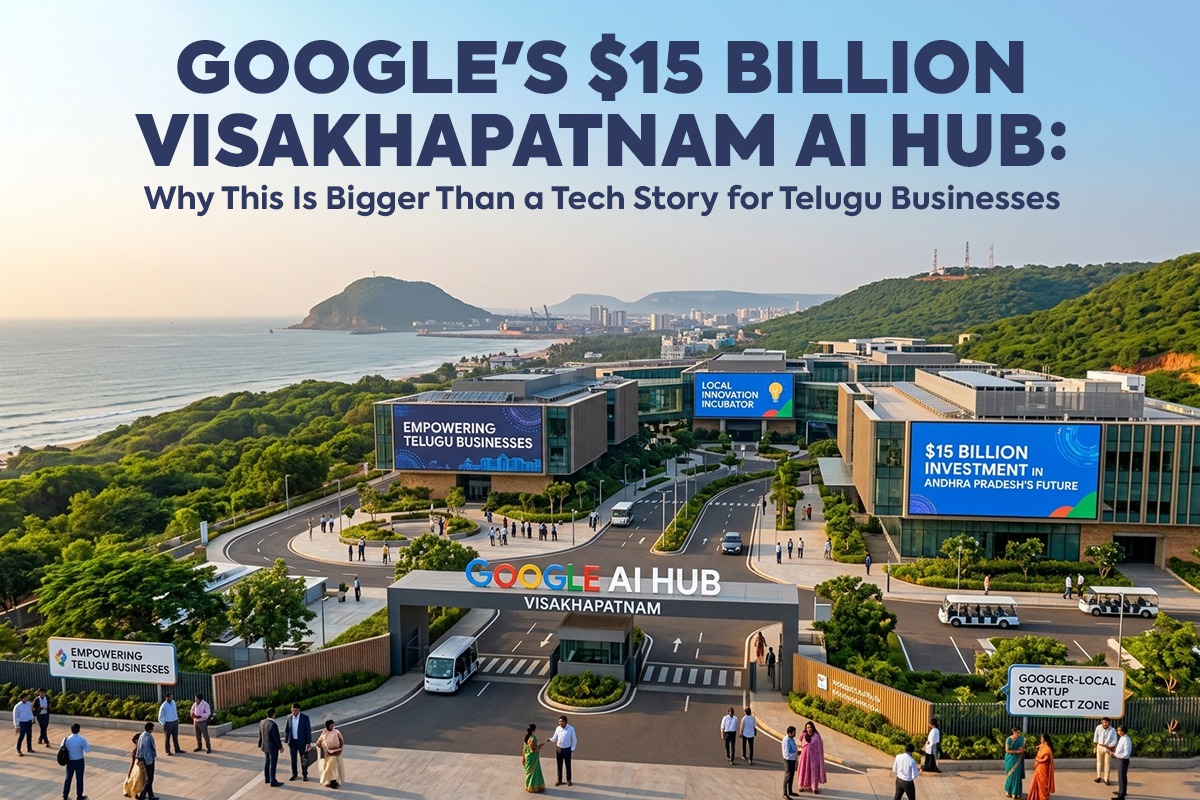
Why This Is Bigger Than a Tech Story for Telugu Businesses
On April 28, 2026, Google broke ground on what will become its largest AI hub outside the United States. The location: Visakhapatnam, Andhra Pradesh.
Most coverage of this story focused on the headline number. The deeper story is what a $15 billion, multi-year commitment to a single Indian state signals about where consumer attention, search infrastructure, and digital commerce are heading next.
For businesses across Andhra Pradesh and Telangana, this is not a tech industry story. It is a market-positioning story with a closing window.
What Changed
Google broke ground on its landmark AI hub in Visakhapatnam, Andhra Pradesh, as part of a $15 billion investment over five years to establish a comprehensive AI ecosystem in India. The announcement places Andhra Pradesh on a very short list of global locations Google considers strategic for AI infrastructure.
Three details matter more than the headline.
First, this is happening alongside the rapid India rollout of Google's AI search products. AI Mode reached over 100 million monthly active users across US and India markets, processing over 1 billion monthly queries. India isn't a secondary market for AI search — it's a primary one.
Second, Google has publicly committed to expanding AI Mode into Hindi and regional Indian languages. The Visakhapatnam infrastructure exists in part to support that linguistic expansion. Telugu-language AI search is no longer a question of if — it's a question of when.
Third, the broader AI search shift is already in motion. Google has expanded AI Overviews to 200+ countries and 40+ languages, and reports a 10%+ increase in usage in major markets like India for the kinds of queries where AI Overviews appear. The infrastructure investment isn't preparing for the future. It's catching up to the present.
Why This Matters for Telugu-Speaking Businesses
The Andhra Pradesh and Telangana market has historically been served by English-first digital marketing — even though a significant share of consumer search behavior happens in Telugu, code-mixed Telugu-English ("Tenglish"), or transliterated Telugu queries.
When Telugu AI Mode arrives, several things will happen at once.
Search volume in regional language will surface. Queries that today are typed in awkward English by Telugu-speaking users will be typed naturally in Telugu. The total addressable search market for Telugu businesses will look meaningfully larger overnight.
English-only websites will lose visibility. AI Mode synthesizes answers from sources it can read. A furniture retailer in Hyderabad with a fully English website will be invisible to a Telugu-language query, even if the brand is locally dominant.
Regional content depth becomes a moat. Brands that have already published Telugu blog content, Telugu video scripts, Telugu landing pages, and Telugu social content will have years of indexable material when Telugu AI Mode goes live. Competitors starting from zero will need 12-18 months to catch up.
A few concrete scenarios from the verticals we serve in this region:
• A fertility clinic in Banjara Hills that has published Telugu patient education content on PCOS, IVF, and IUI will be the natural source for AI-generated Telugu health answers. A competing clinic with only English content will not appear.
• A school in Secunderabad that has translated its curriculum guides, fee structures, and admission FAQs into Telugu will be cited when parents ask Telugu queries about school selection. English-only schools will be skipped.
• A furniture chain with 18 showrooms across Hyderabad and Bengaluru that publishes Telugu product comparisons and care guides will dominate Telugu commerce queries — while larger national brands without regional content lose share in the local market.
This signals a bigger shift: regional language is moving from a "nice to have" to a primary visibility channel.
Strategic Implications for Marketers
The Telugu market has been digitally underserved on the content side for two reasons. Translation has been treated as an afterthought, and Telugu SEO has historically delivered weaker measurable returns than English SEO.
Both assumptions are about to flip.
Translation as afterthought is now a liability. AI search is reading content for meaning, not matching keywords. Machine-translated content with awkward phrasing will be passed over for content that reads like it was originally written in Telugu. Regional language content quality is now a ranking factor in a way it never was before.
The "weak ROI of regional SEO" assumption is breaking. That weak ROI existed because traditional Telugu search volume was lower. AI Mode in Telugu will compress years of organic search growth into months. Early movers will capture share before search volume normalizes.
Cultural fluency becomes a competitive advantage. A Hyderabad business that understands Sankranti gifting cycles, regional festival calendars, Telugu naming conventions for products, and the difference between Telangana and Coastal Andhra dialects will produce content that AI Mode treats as authoritative. National brands operating from Mumbai or Delhi will struggle to match this depth.
The brands that adapt early will quietly accumulate citation share for two to three years before competitors realize what's happening.
Practical Actions: A 30/60/90-Day View
Immediate (next 30 days)
• Audit your existing Telugu content footprint. Most businesses we audit have less than 5% of their digital content in Telugu, even when their customer base is 60%+ Telugu-speaking. Establish a baseline.
• Identify the 10 highest-intent commercial queries in your category and translate them into natural Telugu, not literal English-to-Telugu word swaps. This becomes your initial content roadmap.
• Set up Google Business Profile in Telugu where applicable. This is one of the highest-impact, lowest-effort regional visibility moves available right now.
Short-term (next 90 days)
• Build out 15-20 core Telugu pages covering your highest-converting service areas, product categories, or educational topics. Prioritize originality over volume — AI Mode favors information gain over repetition.
• Add hreflang tags and proper schema markup to signal Telugu pages to search engines correctly. Most Indian sites get this wrong, which means AI Mode treats their regional content as duplicates rather than separate language assets.
• Begin a Telugu video content stream — even short-form. AI Mode increasingly synthesizes from video transcripts, and Telugu video has substantially less competition than Telugu blog content.
Long-term (next 6-12 months)
• Develop a Telugu content engine that publishes consistently. One high-quality Telugu article per week beats ten low-quality translations per month for AI citation purposes.
• Build regional E-E-A-T signals. Author bios in Telugu, Telugu media coverage, regional industry association memberships, regional case studies. Entity authority is local before it's national.
• Track Telugu search visibility separately from English. Most analytics setups don't segment by language, which means regional gains and losses get hidden in aggregate data.
Sampoorna Digi Insight
We've been operating in the Telugu market long enough to see the cycle that's coming.
In 2008-2010, English websites won everything because Indian search was English-first. In 2014-2016, mobile-optimized sites won because search shifted to mobile faster than most businesses adapted. In 2020-2022, video-first brands won because YouTube and Instagram became primary discovery channels.
Each of these shifts had a 12-24 month window during which adapters captured disproportionate share. Each had a longer tail during which non-adapters quietly lost ground without being able to identify the cause.
Our prediction: Telugu-language AI search will be the next such window in Andhra Pradesh and Telangana, opening sometime between Q3 2026 and Q1 2027. The Visakhapatnam hub isn't a coincidence — it's the infrastructure that makes the rollout viable. The brands that have Telugu content already indexed and cited when that window opens will own the regional AI search landscape for the rest of the decade.
The brands that wait for confirmation will be confirming it from behind.
Conclusion
Google's investment in Visakhapatnam is a signal, not just an announcement. It tells regional businesses that Telugu, Andhra Pradesh, and the broader South Indian market are moving from peripheral to central in the global AI search story.
The strategic question isn't whether to prepare for Telugu AI search. It's whether to prepare before the rest of the market does, or after.
If you're thinking about how your business should position for the regional AI shift, our team has been working on Telugu-first content strategies across education, healthcare, and retail for several years. Happy to share what we're seeing across our client base.
Distribution Assets
Social pull-quotes
• "Google's $15B Visakhapatnam AI hub isn't a tech story. It's a market-positioning story with a closing window for Telugu businesses."
• "Telugu AI search is coming. Brands with regional content already indexed will own the next 5 years. Brands waiting for confirmation will confirm it from behind."
• "Translation as an afterthought used to be acceptable. In AI search, it's now a liability — machine-translated content gets skipped for content that reads like it was written in Telugu."
LinkedIn long-form post (~1,400 chars)
Google just broke ground on a $15 billion AI hub in Visakhapatnam. Most news coverage focused on the number. The real story is what it signals — and what closes if Telugu businesses don't move now. Here's what most reporting missed: → This is Google's largest AI hub outside the US → It directly supports Hindi & Telugu AI search rollout → AI Mode is already at 100M+ monthly users in India → Google has committed to multi-language AI search expansion For Andhra Pradesh and Telangana businesses, this means a window is opening. And it has a closing date. When Telugu AI Mode goes live (we expect Q3 2026 - Q1 2027), three things happen at once: 1. Telugu search volume surfaces — queries that were typed in awkward English will move to Telugu 2. English-only websites become invisible to Telugu queries 3. Brands with existing Telugu content get cited; brands starting from zero need 12-18 months to catch up We've seen this pattern before: • 2008-2010: English-first websites won • 2014-2016: Mobile-first won • 2020-2022: Video-first won Each had a 12-24 month window. Each had a long tail of businesses that quietly lost ground without knowing why. Telugu-language AI search is the next window. Brands that have Telugu content indexed when AI Mode goes regional will own the citation landscape for the rest of the decade. Brands waiting for confirmation will be confirming it from behind. 30/60/90-day playbook in the comments.
Twitter/X thread (8 tweets)
1/ Google just broke ground on a $15B AI hub in Visakhapatnam. Most coverage talked about the dollar figure. The real story: a closing window for every Telugu-speaking business in AP & Telangana. Here's why 
2/ This isn't just an infrastructure announcement. It's the backend for Telugu & Hindi AI Mode. Google has publicly committed to regional language AI search expansion. Visakhapatnam is what makes it viable at scale.
3/ India already has: → 100M+ monthly AI Mode users → 1B+ monthly AI Mode queries → AI Overviews in 40+ languages → 10%+ usage lift on AI-eligible queries India is not a side market. It's the primary growth surface.
4/ When Telugu AI Mode goes live, three things happen at once: • Telugu search volume surfaces (queries shift from English to native) • English-only websites become invisible to Telugu queries • Brands with existing Telugu content get cited; others wait 12-18 months
5/ History rhymes: • 2008-2010: English-first websites won • 2014-2016: Mobile-first won • 2020-2022: Video-first won Each shift had a 12-24 month window. Each had a long tail of businesses that quietly lost ground. Telugu AI search is next.
6/ Two old assumptions just broke: • "Translation is an afterthought" — now a liability • "Telugu SEO has weak ROI" — based on pre-AI volumes AI search reads content for meaning. Machine-translated Telugu gets skipped. Native-quality content gets cited.
7/ Cultural fluency is now a moat. Understanding Sankranti cycles, Telangana vs Coastal Andhra dialects, regional festival calendars, Telugu product naming — Mumbai/Delhi national brands can't fake this. Local businesses with depth win.
8/ Prediction: Telugu AI Mode rolls out between Q3 2026 and Q1 2027. Brands with Telugu content already indexed will own regional citation share for the rest of the decade. Brands waiting for confirmation will confirm it from behind. The window is open. Briefly.