
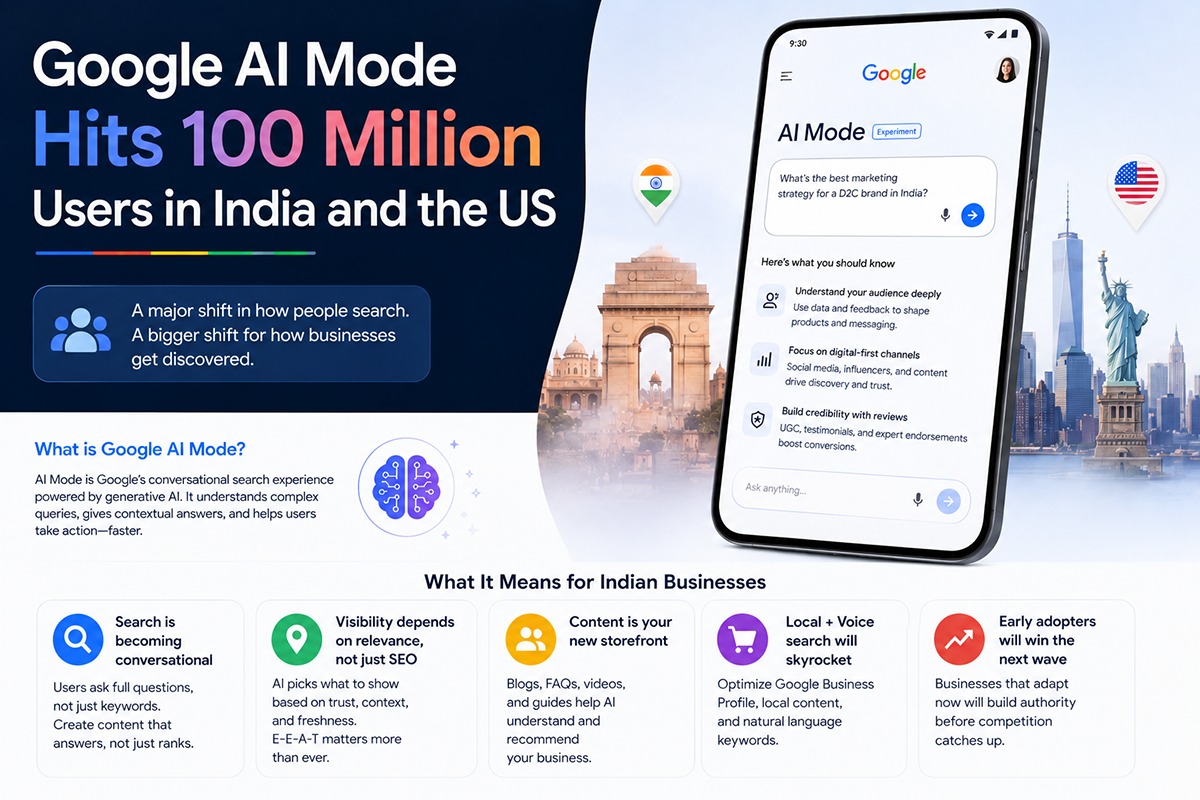
In May 2025, Google quietly launched a new search experience called AI Mode. By early 2026, it had crossed 100 million monthly users across the US and India — making it one of the fastest-adopted search interfaces in Google's history.
For most Indian business owners, this number means nothing. For their marketing performance over the next 12 months, it means everything.
This article explains what AI Mode is, why India is central to Google's strategy, and what businesses across Hyderabad, Bengaluru, and Tier-2 cities should be doing right now to stay visible.
What Changed
Google AI Mode is not the same as AI Overviews. AI Overviews are the AI summaries that sit above traditional search results. AI Mode is a separate, end-to-end search experience powered by Gemini — closer in feel to ChatGPT than to classic Google.
The difference matters. In AI Mode, there are no ten blue links. You either get cited, or you don't appear at all.
Behind the scenes, AI Mode uses something Google calls "query fan-out." When a user types a question, the system breaks it into subtopics and runs multiple searches simultaneously — up to 16 searches — then synthesizes the answers. That single shift changes the rules of SEO. You're no longer optimizing for one keyword. You're being evaluated against an entire cluster of related queries the user never typed.
India is not a test market for this. AI Mode reached 100 million monthly active users across US and India markets within months of launch, processing over 1 billion monthly queries. And Google broke ground on its landmark AI hub in Visakhapatnam as part of a $15 billion investment over five years to establish a comprehensive AI ecosystem in India. Hindi and regional language support for AI Mode is in active development.
The translation: India is core infrastructure for Google's AI search future, not a side experiment.
Why This Matters for Indian Businesses
Most Indian SMEs have spent the last decade building SEO around one model — rank for a keyword, get a click, convert the click. AI Mode breaks that chain in three ways.
Click volumes are dropping, even at the top. Independent data shows Position-1 CTR is down 58% on AI Overview queries. When AI Mode adoption follows the same curve, ranking #1 will deliver a fraction of the traffic it did in 2023.
Visibility is decoupling from traffic. A coaching institute in Hyderabad may be cited in AI Mode answers across hundreds of queries — admissions, course comparisons, fee structures — and see almost none of those citations as website visits. The brand is being read; the analytics dashboard shows nothing.
Ranking signals are shifting from keywords to entities. AI Mode doesn't ask "does this page mention the keyword?" It asks "is this brand a recognized authority on this topic across the web?" That's a fundamentally different game.
Consider three quick scenarios from verticals we work in:
- A multi-location furniture retailer ranks well for "modular sofas Hyderabad" today. In AI Mode, the user asks "what's the best modular sofa under ₹80,000 with 5-year warranty in Hyderabad?" — and the answer pulls from review sites, YouTube videos, and brand pages with structured comparisons, not just the SEO-optimized landing page.
- A fertility clinic ranks for "IVF cost in Hyderabad." In AI Mode, the user asks "how do I choose between IVF and IUI for a 34-year-old with PCOS?" — a clinic with deep, structured educational content gets cited; a clinic with thin service pages does not.
- A school ranks for "best CBSE school Secunderabad." In AI Mode, parents ask "which Secunderabad schools have the strongest STEM programs and how do their fees compare?" — schools that publish detailed program information win; schools relying on brand-name SEO lose ground.
For businesses, this means the website is no longer the destination. It is the source material an AI assistant uses to recommend you.
Strategic Implications for Marketers
Three playbooks are quietly going obsolete in 2026.
The keyword-density playbook is finished. Stuffing variations of "best digital marketing agency Hyderabad" into a page no longer wins anything in AI Mode. The system is reading for clarity, completeness, and credibility — not phrase repetition.
The single-page ranking strategy is breaking. AI Mode evaluates topical authority across an entire site and across the web. One well-optimized page surrounded by thin content does not signal expertise. Depth of coverage on a topic does.
The traffic-as-success-metric is misleading leadership. Marketing teams reporting only on sessions and pageviews will look like they are failing while the business is actually gaining brand exposure across AI surfaces. The reporting framework needs to change before the conversation with founders gets harder.
Here's what most marketers miss: AI Mode is not punishing good SEO. It is rewarding a different kind of good SEO — one built on entity recognition, structured content, and verifiable expertise rather than keyword optimization alone.
The brands that adapt early will own disproportionate share of voice in AI answers for the next three to five years. The ones that wait for "more data" will be playing catch-up against competitors who built citation-worthy content while the window was open.
Practical Actions: A 30/60/90-Day View
Immediate (next 30 days)
- Audit your top 20 commercial pages for direct, extractable answers. Each page should contain at least one paragraph that fully answers a single user question in under 60 words.
- Implement FAQ schema, Article schema, and Organization schema across priority pages. AI Mode favors machine-readable content.
- Create a baseline citation log. Manually search five high-intent queries in AI Mode and record which competitors are being cited. This is your starting line.
Short-term (next 90 days)
- Rebuild your highest-traffic pages around topical clusters, not single keywords. Each pillar page should link to 6-10 supporting articles that cover related subtopics in depth.
- Publish original data, original case studies, or original frameworks. AI Mode prioritizes "Information Gain" — it looks for unique data, expert quotes, and proprietary research. Generic content gets summarized; unique content gets cited.
- Strengthen E-E-A-T signals. Add author bios with credentials, link to LinkedIn profiles, cite real case work, display verifiable client names and outcomes where contractually possible.
Long-term (next 6-12 months)
- Build entity authority across the web. Consistent NAP listings, Wikipedia or Wikidata presence where eligible, mentions on industry publications, active LinkedIn presence, and verified Google Business Profile.
- Expand reporting to include citation frequency, branded search lift, and AI visibility tracking. Tools like Ahrefs Brand Radar and Semrush AI Tracker now offer this; even manual quarterly tracking is better than none.
- Prepare regional language content. Hindi and Telugu AI Mode rollouts are coming. Brands with regional content depth will have a 12-month head start over competitors who only publish in English.
Sampoorna Digi Insight
What we're seeing across our client base in education, healthcare, and furniture is a clean split forming.
Brands that invested in genuine content depth over the last 18 months — long-form guides, real case studies, proper schema, regional language pages — are starting to appear in AI Mode citations even when they don't rank #1 in traditional results. Brands that relied on keyword volume and link velocity are losing visibility faster than the broader traffic decline would suggest.
Our prediction: by Q4 2026, AI Mode and AI Overviews together will influence 60-70% of high-intent commercial queries in India. The businesses that win this period won't be the ones with the biggest SEO budgets. They'll be the ones with the clearest expertise, the cleanest content structure, and the strongest entity footprint across the open web.
The fundamentals of search aren't dead. They've just been raised.
Conclusion
Google AI Mode reaching 100 million users isn't a future trend. It's a current condition that's already reshaping how Indian customers find businesses. The brands that treat this as a structural shift — not a passing update — will compound visibility advantages over the next two to three years. The ones that wait will find the cost of catching up far higher than the cost of adapting now.
If you're rethinking how your business shows up in AI search, our team works with brands across India navigating exactly this shift. Happy to share what's working across the verticals we serve.